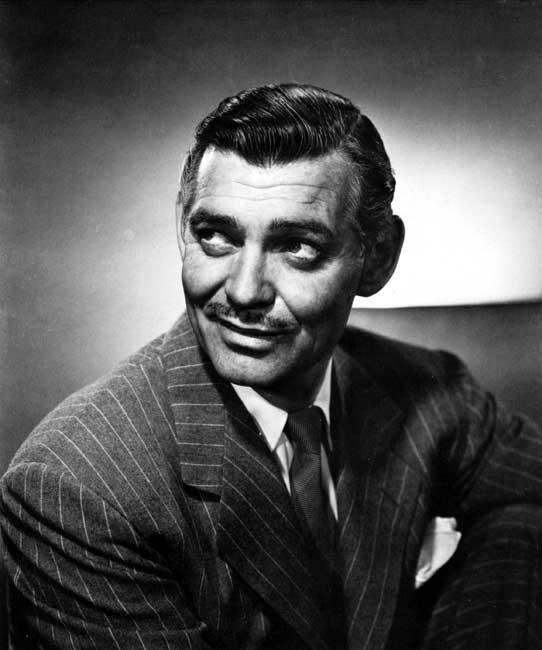
Showing posts with label Clark Gable. Show all posts

Saturday, April 28, 2012

How this all got started

I was thinking today about how my love of classic movies began. The first classic movie I remember seeing is "Gone With the Wind" in 8th grade. (Well, I saw "The Wizard of Oz" long before that, but GWTW was what started my love.)

We read the book in English class, and everyone loved it (despite the groans that came at first when we were handed the book and realized it was over 1000 pages). I can still remember the day the class geek, who had finished way before any of us, horrified everyone by blurting out the Melanie dies at the end. Anyway, after we finished reading this behemoth, our teacher treated us by showing us the movie in 45 minutes chunks each period for about a week. We were just dazzled. Or at least I was.

Casting: Clark Gable was, of course, the perfect Rhett Butler. Whether Margaret Mitchell had in mind when she wrote the book or not, no one else could have played that role, ever. Olivia de Havilland had that quiet, gentle manner that was just right for Melanie. Had no idea Vivien Leigh was British until years later.

The one cast member that wasn't quite right was Leslie Howard. If you've read the book you'll understand why. The first description of Ashley goes like this:

"...his drowsy grey eyes wide with a smile and the sun so bright on his blond hair that it seemed like a cap of shining silver."

And later, when he comes home on Christmas furlough:

"The Ashley Wilkes in his faded, patched uniform, his blond hair bleached tow by summer suns, was a different man from the easy-going, drowsy-eyed boy she had loved to desperation before the war. And he was a thousand times more thrilling. He was bronzed and lean now, where he had once been fair and slender, and the long golden mustache drooping about his mouth, cavalry style, was the last touch he needed to make him the perfect picture of a soldier."

Somewhere I think it also mentions that Ashley is over six feet tall. So imagine our surprise when we get to the barbecue scene of the movie, Scarlett calls out, "Ashley!", and this guy comes down the stairs:

And he has a British accent.
I am sorry to say that we all burst out laughing. Poor Leslie Howard, who was so great in many other roles, and was shot down by the Germans in 1943, was spectacularly unsuited for this role.

Not long after that, a new video rental place opened, with a much bigger selection than your average Blockbuster, including a great selection of old movies. They were usually shelved by actor/actress, so I began working my way through the Joan Crawford shelf, and the rest is history.

Wednesday, July 13, 2011

Sporting Blood

Comcast description of movie: Racetrack yarn with Clark Gable as a gambler who saves a horse from mistreatment.

My description of movie: The life and times of a horse named Tommy Boy. Clark Gable shows up half way through.

I was a little wary of watching this movie during the first couple minutes, because it has animals in it and I know the studios did not treat them well back then, and thus today we have the disclaimer "no animals were harmed..." (dear God, 20th Century Fox, you rode a blindfolded horse off a cliff to its death?).

In the first 10 minutes, Tommy Boy's mother Southern Queen falls down in the mud while trotting back to the stable, and you can see, briefly, that she appears to be tied down by her back leg as she thrashes in the puddle and stuggles to get up. Sadly, her leg is broken, and she has to be shot right there on the spot, leaving our hero, Tommy Boy, an newborn foal without a mother.

The owner of the horse farm, Jim Rellence, (scenes are actually filmed in Kentucky) where Tommy is raised loves him very much, but he eventually has to sell him because he needs the money. The new owner (whose name escapes me) ends up selling Tommy to a spolied rich woman (Marie Prevost) and her husband (Hallam Cooley), who obviously know nothing about taking care of a horse.

"I don't want him anymore. Just shoot him!" (Sadly, an actual quote.)
After Tommy loses a race, they lose interest and sell Tommy to a crooked gambler, Tip Scanlon (Lew Cody) who runs the horse into the ground with doping and too much racing. Before he's killed over a bad bet, he gives the horse to his girlfriend Ruby (Madge Evans) who decides to rehabiliate Tommy, and herself and ends up reforming slightly crooked gambler Rid Riddell (Clark Gable) in the process.

It's one of those feel-good animal movies, and apparently based on a true story of a horse named Sporting Blood and his owner, gangster Arnold Rothstein, who brought us the 1919 Black Sox scandal, so I suppose doping a racehorse and fixing a race should come as no surprise.

Best part of the credits: Tommy Boy played "By Himself." Nothing like starring in the movie of your own inspirational life story. ;)

Cute picture, although this is not actually Tommy Boy.


Monday, August 04, 2008

They Met In Bombay

July was Roz Russell month on TCM, so I have a boatload of her movies saved on my DVR. Last week I watched They Met in Bombay, which starred Clark Gable in the kind of role I think he does best: the guy whom the girl thinks she hates but is really falling in love with, and he knows it. From almost any other actor, I think I might find that "yeah, baby, you know you love me" attitude annoying, but Gable pulls it off with a sideways glance and crooked grin that I love. Sort of like this, except imagine him looking down at a dame. (Can't get the image to upload, so just a link for now.)

He and Roz are competing jewel thieves who end up escaping from the law together, falling in love, and going straight. Much like the Gable/Harlow movie Hold Your Man, the beginning starts out all snazzy wisecracks and ends up kind of mushy. Roz's doe eyes couldn't have gotten any more limpid or starry, and she did lose a lot of the pizzaz that I usually love her for. I thought some interest was added to the "Gable becomes a hero" part of the story by including Roz in his adventures as a fake Winnipeg Grenadier escaping from the Japanese army; usually the women get left at home during these kinds of escapades.

Included in the cast was one of my favorite character actors, Jessie Ralph, as the raucous and tipsy Duchess of Beltravers. She is a scream in these kind of "fiesty matron" parts; she plays another duchess in The Last of Mrs. Cheyney, which is another role of hers I like. My all time favorite, though, is Jessie as Aunt Katherine ("Nic-oh-las!") in After the Thin Man.

While this movie could easily fall into a "romantic caper" pigeonhole along with dozens of other movies, I would still recommend it.

On a totally unrelated note, IMDB has just informed me that they're remaking The Day The Earth Stood Still. (Keanu Reeves? Really?) Must they remake every classic movie just to jazz it up with CGI and rock music?

Monday, July 17, 2006

Gable vs. Gable


I received my Gable box set right on time, and I've been working my way through the movies since then. Some of them I had already seen: Dancing Lady, China Seas, and Wife vs. Secretary (now I can sell my VHS tapes on eBay). The other weekend was an action double feature with Boom Town and San Francisco. Last night was Mogambo, which of course I had to compare with its previos incarnation, Red Dust.

Mary Astor vs. Grace Kelly? Eh, I could take or leave either of them. Grace was a little too uptightly British, I thought. Mary Astor did the shooting scene better. It was easier to believe her outraged emotions. Grace just screamed and twirled around and hid her face in her hands in a cliched bit of overacting.

Jean Harlow vs. Ava Gardner? This one was closer, but I'm going to have to give it to Jean here, because I just adore her. Her character, as a prostitute, was tougher and in a way, more interesting, and therefore more of a contrast to the other woman (Grace/Mary) than Ava's society lady character was.

Gene Raymond vs. Donald Sinden? I guess we'll call this one a tie. I like Gene as an actor better mainly due to his role in Sadie McKee, but Donald did a good job as the husband. He seemed alittle less clueless than Gene Raymond sometimes. But only a little.

Philip Stainton was quite likeable as Gable's sidekick, Brownie. I don't remember the equivalent character in Red Dust, if there even was one (it's been a few years since I saw it) so Stainton wins by default. He was jolly and fun but also serious about his job and the dangers of the jungle.

As far as the love story goes, I'm about even with both versions of Gable pining away after the saintly English wife. Even though I prefer Harlow to Gardner, I did like Gable's relationship with the latter better. There seemed to be more fondness between the two. In RD I got the impression Gable thought of Harlow as little more than a warm body. He's so mean to her sometimes, you wonder how she can go on loving him. There was more genuine liking and tenderness between Gable and Gardner.

As it stands, the box set is an excellent one. I stand by my earlier thought that I would have substituted one of the Gable action movies with Spencer Tracy for the great gangster film Manhattan Melodrama. Since Jeanette MacDonald doesn't do much for me, I would have pulled San Francisco for MM.

So many of Jean Harlow's movies have now been released on DVD on their own and as part of other people's box sets, that there aren't a whole lot left (she only made 41, and that's generously including the bit parts) for a "signature collection" set of her own (and she absolutely should have one). Here's what I would include in her set:

Bombshell
The Girl From Missouri
Hold Your Man
Red-Headed Woman
Reckless (well, maybe not; not such a great film)
Suzy (I'm kind of lukewarm about this one; her undying love for cad Cary Grant kind of annoyed me)

A lot of her other movies I have never seen, so I can't really say for sure which ones I would include. Additional options include:

Saratoga
Personal Property
Riffraff

I'm only counting movies that aren't on DVD already (and there's more than I thought). Of course some could be rereleased, like they did with Mildred Pierce when they made the Joan Crawford box set.

Again I ask: Ted Turner, are you listening? ;)

Sunday, April 16, 2006

It's Alive!

No, no, not Frankenstein. The Clark Gable Signature Collection! He should have been the first to get one, being the "King of Hollywood" and all, but at least he has one now. Or he will, come June. I've already pre-ordered mine.

I found the selection of movies somewhat surprising:

Dancing Lady
China Seas
San Francisco
Boom Town
Wife vs. Secretary
Mogambo

First, I thought I was the only one who adored Dancing Lady and thought it a great example of Gable's work. He is good in that film (everyone is), but I think instead I would have selected Forsaking All Others, which is a fabulous witty drawing-room romatic comedy with some great zingers in the dialogue. It's just a joy to watch. I've talked about it before.

China Seas I like, but I would have picked Red Dust for a Jean Harlow/Gable pairing for this set, especially since Mogambo was also chosen, and it's a remake with Ava Gardner and Grace Kelly in the female roles. Maybe that would have seemed repetitive, but on the other hand, it could be interesting to compare the two.

I love Wife vs. Secretary and would have chosen that one myself. It's another great example of Gable being wonderfully happy-go-lucky, and it also has romance and some drama. Also great costars in Myrna Loy, Jean Harlow, and Jimmy Stewart. It was one of Harlow's rare "good girl" roles, and her favorite, so that makes it doubly a good choice.

I've never seen San Francisco or Boom Town, so I'll have some comments about those after I get my boxed set in June. I'm counting the days. ;) If they wanted a "tough guy" role, which I suspect these are, I would have chosen Manhattan Melodrama in place of one of those.

Next up, I would LOVE to see a box set of Joan Crawford/Clark Gable movies. This set would include:

Chained
Possessed
Strange Cargo
Dance, Fools, Dance
Laughing Sinners
Forsaking All Others
Love on the Run

Come on, Ted Turner. Make my day. :)

Sunday, April 02, 2006

Pilgrim? Duuuuude!

Last night I watched The Man Who Shot Liberty Valance, which I think has become my new favorite Western (a close second behind Dodge City). I'm going through a John Wayne phase right now, and Jimmy Stewart is always a winner in my book, so I decided to give this one a viewing. Rounding out the cast are Vera Miles, Andy Devine, and the uber-macho Lee Marvin (who, I was interested to discover, was a Marine and is buried at Arlington). When I saw the Netflix sleeve, I thought, "oh, geez, two hours," but the time flew by with this one.

I didn't realize this was the movie that started a million John Wayne imitations with "howdy, pilgrim." That's his nickname for Jimmy Stewart, and it sticks all through the movie; I couldn't help but giggle every time he said it, because it has become such a staple of the John Wayne persona. Also sort of darkly amusing yet also menacing is Lee Marvin's nickname for Jimmy, "dude," which he bullfrogs in a suitably sinister way. There was a decent amount of action and suspense; although I figured out right away who shot Liberty Valance, and not too long after realized how the rest of the plot would unfold, I did find myself tensing up in a few of the most dramatic scenes. When John Wayne goes home and throws the lamp into the half-finished addition to his house, it's such a painful moment, emotionally. You don't think of Duke as going to piece over a woman, but he does it here; knowing from the start of the movie how he ended up makes it even more difficult to watch, because you know this is the beginning of his downward spiral in that moment.

One thing that stuck in my mind, because I am obsessed by these kind of small details: the hairstyles. Duke looked all right, but Jimmy's hairpiece looked like a dead badger with an Elvis curl over the forehead. And Vera Miles, with her 60's bouffant with two braids clipped to the ends...not very frontier. Yes, I am insane.

Another movie, which I ended up spacing out over the course of the entire week, was one of my favorite Joan Crawford/Clark Gable pairings, Possessed. I'm a sucker for a good romance story where one person does something noble for the benefit of the other; here Joan pretends to be bored and sick of her lover Clark so she won't ruin his reputation when he runs for governor in the near future. The look on her face, which we see over his shoulder as he embraces her and proposes marriage (which she has long waited for) goes through so many emotions so beautifully, from a flash of joy to regret to steeling herself to hurt him so he'll let her go. And Clark's face, as he goes from laughter to disbelief to an angry resignation that Joan has made a fool of him...you can almost feel the ice hardening around his heart. Oh, I know I'm talking like a bad romance novelist, but I do love those two, best of all when they act together.

Saturday, August 06, 2005

Clark and Olive

I know, a random pairing. It's just what I've been watching lately.

I’ve read in several books that Clark Gable was never the same after the death of Carole Lombard. Well, who would be. It was evident, the various authors said, by comparing his films before and after 1942. Again, I thought: of course he’s going to be different, he lost his wife in a fiery plane crash and then joined the army and flew bomber missions! Jimmy Stewart did more or less the same, and came back with slightly thinner and grayer hair, maybe, but nothing drastic. How much worse could Gable look?

I found out the other day, when I watched Teacher’s Pet. Okay, granted, this movie was made in 1958, so it was only two years before Gable died and over ten since the war had ended. But yikes, he did not age well. The only other “late Gable” movie I’d seen was Run Silent, Run Deep, and yes he looks old, but you kind of expect the grimness, seeing as how it’s a WWII submarine movie. Teacher’s Pet is a romantic comedy; in brief, Gable the journalist goes undercover to Doris Day’s journalism class to disprove its usefulness, and they fall in love. His character is a crusty sort of newshound, but not overly so. But there’s none of the joy or daffy romance with which Gable would have played this character in say, the 1930’s. I’m reminded of one his own quotes (which I’ve cadged from IMDB): "The only reason they come to see me is that I know that life is great -- and they know I know it." I didn’t get any of that feeling in Teacher’s Pet.

I've also recently watched Forsaking All Others, which is a wonderful light comedy written by Joseph Mankiewicz, which also stars Joan Crawford, Robert Montgomery, Billie Burke, Rosalind Russell, and Charles Butterworth. The dialogue is full of zingers and the action often borders on the goofy. Gable is smooth and urbane yet also happy and full of boyish mischief, always ready with a wisecrack and a hearty laugh. In comparing these two performances, Teacher’s Pet comes off the worse. (Probably not helped by the fact that Gable seems old enough to be Day’s father.)

Thinking it over, though, it’s not really a good comparison. I suppose to be really fair, I should watch Somewhere I’ll Find You, the movie he was filming when Carole was killed (or maybe Honky Tonk, the one before that), and then Adventure, his first movie after the war (Gable’s back and Garson’s got him, so on and so forth).

Next up was the wee little Olive Thomas Collection, which consisted of a documentary (Olive Thomas: Everybody’s Sweetheart) and a film (The Flapper). I had heard of Olive before, primarily through (I’m ashamed to admit) Hollywood Babylon. That picture of her in the straw hat, with big eyes and long curls down her shoulders, is so lovely. When Netflix suggested the DVD, I went ahead and bumped it to the top of my queue.

The documentary was good, augmented by the inclusion of several of Olive’s family members. Frankly, though, I thought Olive’s many sketches (at the hands of Christie and Vargas, among other illustrators) were more beautiful than Olive herself. In some of her photos, she was very pretty. When I saw her in The Flapper, she was pretty, but not what I would label “the most beautiful girl in New York.” I guess it’s all a matter of what was in vogue at the time, though. Which was not, apparently, perfect teeth. (Okay, I said it. And not to be mean to poor Olive, but I just couldn’t help noticing it through out The Flapper.) I thought she was cute, and enjoyed the movie. I’ve never been a huge fan of the silents, although they’re starting to grow on me.

Friday, July 22, 2005

Old favorites

A favorite movie is like a warm bath. I have different movies for different moods. The ones I’ve seen a frillion times I’ll sometimes put on just for company/background noise while I’m cooking or doing other things around the house, kind of like listening to baseball on the radio, which I also do. Of course, I often sit down just to watch them, too; a good movie can be background noise, but it is of course much more than just that. It’s an entertaining old pal.

Yesterday I was feeling under the weather, so when I finally dragged myself from bed I popped in "The Women," a tried and true favorite. I rented it one day a few years back out of curiosity, after seeing the DVD case on the shelf at TLA, and after I saw it could not believe I had been without this delicious film in my head up to that point.

It’s so delightfully witty; I think the humor holds up even by today’s standards. If the rumors are correct and they are going to remake the movie (which is a bad idea, but you know how the studios are), they could use all the same dialogue, and it would still be funny. Of course they’ll sex it up a lot, but hopefully they’ll keep the gold standard of not having any men in the movie. No, really. None whatsoever. Even the dogs were all female. That was Cukor’s idea, I heard. The movie’s tag line may be "It’s all about men!" but you won’t see one here. Not everyone notices this, and I love to point it out afterwards. "There must be at least one man," people say, "A butler, something." Nope, nary a man in sight throughout.

I’ve read the play, and it’s equally good. The character of Mary Haines is a little less sunshiny-sweet than she is in the movie, which makes it more balanced. It’s a fast and amusing read. I still think Crystal Allen has the best exit line ever: "There’s a name for you ladies, but it isn’t used in high society...outside of a kennel." I want that on a bumper sticker.

Later in the day I watched "Chained," which I think may be the first Joan Crawford/Clark Gable movie I ever saw. My local TLA had a decent collection of them, and they comprised most of my early classic movie viewing. I wish they didn’t tease out Joan’s hair quite so much, but she is just adorable as she walks the ship’s deck with Clark, or swims in the pool with a wee Mickey Rooney (in an unbilled cameo role). Watching her devour roast chicken and milk for lunch with Clark and Stu Erwin always makes me hungry for a good, home-cooked meal.

Food in old movies seems so much more wholesome than today, doesn’t it? No strategically placed cans of Pepsi or bags of Doritos. No, it’s big homey meals (with no preservatives!), or the blue plate special in a diner (and even that seems appetizing) or maybe hors d’oeuvres at a swanky cocktail party. Whatever the occasion, the eating is usually good. And most movie stars ate in what I call the "European" style, which means they use both knife and fork, keep the fork in the left hand, and keep the tines pointed downwards. It looks so elegant. I’ve tried it, but I usually end up dropping food all over my lap. I do eat with my left hand, though.

[I just found this post in the drafts folder. It was originally dated 6/29 but I'm posting it with today's date so it floats to the top.]

Sunday, June 26, 2005

Make your own box set!

I can’t believe I didn’t think of this sooner. Well, actually, Borders thought of it already; I think it was last summer. Buy 3 DVDs, get the 4th one free, and you got a handy little sleeve that you could color yourself. I checked it out, but none of the movies appealed to me. Mostly action, sci-fi, that kind of stuff. I’m going to pretend I have the power to release movies on DVD, and create a few box sets that need to be created, posthaste. Major studios and Ted Turner, are you listening? Here we go...

Joan Crawford: The Best of the 1930s

  1. Dance, Fools, Dance
  2. Laughing Sinners
  3. Possessed (1931, obviously)
  4. Rain
  5. Dancing Lady
  6. Sadie McKee
  7. Chained
  8. Forsaking All Others
  9. Love on the Run

Okay, this would obviously be a rather hefty box set**, but I would totally buy it. The new Garbo one coming out this fall has seven sound movies (eight if you count both the German and English versions of Anna Christie) plus three silents and a documentary on ten discs for $69.94 (Amazon price). So how about nine Crawford movies for, say, $49.95? There are more good movies of hers from the 1930s, I just picked my favorites. You could also toss in Letty Lynton, I Live My Life, Gorgeous Hussy, The Last of Mrs. Cheyney, or The Bride Wore Red.


**Pausing to look over some of the other "signature collection" box sets, I see that 9 movies in a set wouldn’t be outrageous at all. Here’s how many movies are in various other box sets:
Cary Grant – 5
Judy Garland – 7
Hitchcock – 9
Errol Flynn – 5, plus a documentary
John Wayne – 4
Hepburn & Tracy – 3, plus a documentary
Elizabeth Taylor – 4

So the bigger, the better is now my motto!

Moving on, let’s take a look at Jean Harlow, who should have had a box set long ago.

Jean Harlow: The Signature Collection
  1. Hell’s Angels
  2. The Public Enemy
  3. Platinum Blonde
  4. Red-Headed Woman
  5. Red Dust
  6. Hold Your Man
  7. Dinner at Eight
  8. Bombshell
  9. China Seas
  10. Wife vs. Secretary
  11. Libeled Lady
  12. Saratoga

I think that would about do it. Most people would probably take out Hold Your Man as it’s not one of her better known films, but I included it because I adore it. Also Saratoga could go, because it is kind of morbid to play "spot the body double." So that would make it an even ten. There’s room to fiddle – I could easily take out China Seas and put in The Girl from Missouri. I find myself inexplicably fascinated with Reckless, but that was pretty much a bomb, so we’ll skip it.

How about...

Judy and Mickey: The Collection

  1. Babes in Arms
  2. Babes on Broadway
  3. Strike Up the Band
  4. Love Finds Andy Hardy
  5. Life Begins for Andy Hardy
  6. Andy Hardy Meets Debutante
  7. Girl Crazy

Or you could just whip up an Andy Hardy box set, although the last one, Andy Hardy Comes Home, has always seemed like a depressing idea to me.

Oh! How could I have almost neglected to mention...

Clark Gable: The Signature Collection

  1. Red Dust
  2. It Happened One Night
  3. Manhattan Melodrama
  4. Mutiny on the Bounty
  5. Test Pilot
  6. Idiot’s Delight
  7. Mogambo
  8. Run Silent, Run Deep
  9. The Misfits

I know I’m missing a lot here, because there are quite a few of his films I haven’t seen. I know there’s one or several documentaries out there, so toss your favorite in. Another idea would be a Clark Gable and Joan Crawford collection.

Norma Shearer: The Signature Collection

  1. The Divorcee
  2. A Free Soul
  3. Private Lives
  4. Strange Interlude
  5. Riptide
  6. The Barretts of Wimpole Street
  7. Romeo and Juliet
  8. Marie Antoinette
  9. Idiot’s Delight

I skipped The Women because it’s been released by itself as well as part of Joan’s new box set. Marie Antoinette should be released on DVD right now, just by itself, because it is a wonderful film, and Norma is fabulous in it.

Other random films that I’d love to see on DVD, not necessarily as part of a box set:

Jane Eyre
No Man of Her Own
I Love You Again
To Each His Own
Love Crazy
The Raven
The Black Cat (1934)

Okay, whoever owns the distributions rights to these movies, you’ve got your work cut out for you. Get cracking!

Monday, April 25, 2005

Character Actors I Love: Ted Healy

If I had to sum up Ted Healy in one sentence, it would be "more than just a Stooge." I don’t care for the Three Stooges at all (don’t email me), but I enjoy the work of their "founding father," Ted Healy. I’ve seen him in 3 movies: Reckless, Dancing Lady, and Bombshell.

Ted was born in Houston in 1896. His real name is a matter of dispute; various sources state it as Ernest Lee Nash, Charles Lee Nash, or Clarence Lee Nash. He gave up the life of a salesman in 1919 and went to work on vaudeville, changing his name to Ted Healy. He and his wife Betty (both his wives were named Betty, so I’m not sure which one it was) had an act called "Ted & Betty Healy: The Flapper and The Philosopher." That must have been interesting, to say the least. In 1923 he founded a stage act with two childhood friends, Moe and Shemp Howard (later joined by Larry Fine) and called it "Ted Healy and His Stooges." Thus a legend was born. Shemp left the act and was replaced by Moe’s brother Jerome, who shaved his head and was known as Curly. The Stooges parted ways with Ted in 1934 when they were offered a contract with Columbia Studios.

Ted and The Stooges were still an act, however, when I first saw him, in Dancing Lady. Ted plays Steve, the assistant to Patch Gallagher (Clark Gable), a Broadway producer. (The Stooges are stagehands who make minor appearances, mainly to tease Joan Crawford.) Steve is not just comic relief but a fairly well-rounded character, somewhat inept on his own but loyal to his boss. In Bombshell, he plays Jean Harlow’s drunken lout of a brother, but doesn’t show up until the second half of the film, just in time to stomp all over her plans to adopt a baby with his bad behavior. In Reckless he’s rather endearing as one of William Powell’s sidekicks, Smiley, another not-too-bright-but-loyal-pal-of-the-leading-man. At the racetrack with a stiff and proper English lady, he’s boorish but funny. I don’t think Ted ever could have been a leading man, but he’s still fun to watch, and gives a good performance. Ted also wrote five films: Nertsery Rhymes, Beer and Pretzels, Hello Pop!, Plane Nuts, and The Big Idea.

Sadly, Ted had a problem with alcohol, which was one of the factors in his split from the Stooges. His only child, John Jacob Nash, was born December 17, 1937, and Ted went out drinking that night to celebrate. He ended up in a bar fight, was found unconscious on the sidewalk, and died on December 21 from his injuries and kidney failure brought on by years of alcoholism. He’s buried in Calvary Cemetery in Los Angeles.

I picked Ted as a CAIL mainly because of his performance in Dancing Lady, which is one of my all time favorite classic movies, ever. I can’t really explain why. It’s not a great epic like Gone With the Wind, or even a popular classic like The Women, two of my other favorites. Dancing Lady is the movie equivalent of comfort food to me; I’ll pop it in even when I’m not planning to sit down and watch it all the way through. It serves as background noise while I’m doing chores or cooking, something I can watch in bits and pieces just to unwind, or I’ll actually sit down for another complete viewing of an old favorite. It has quite a cast: Joan Crawford, Clark Gable, Franchot Tone, Winnie Lightner, Robert Benchley, Ted & The Stooges, May Robson, Nelson Eddy, Sterling Holloway (voice of Winnie the Pooh) and Fred Astaire, playing himself in his first movie role. It’s a musical, a backstage story, a comedy, a love story, a drama. The songs are hokey (example: "Let’s Go Bavarian," about the joys of German beer), and not ones anyone remembers fondly today, but I’ll catch myself humming them under my breath. I’ll stop here because I could (and plan to) do a whole separate entry about this movie, and I didn’t mean to get so far off the original topic. (It was Ted Healy, remember?)

Saturday, April 23, 2005

Simpler times

Myrna Loy, in her autobiography Being and Becoming, wondered about the modern nostalgia for the war years, as evidenced in both movies, and things people had said to her over the years. Why would people look back fondly on such a time, she wondered, which was full of terrible fears and tragedies. I see her point; I suppose people who look back are seeing those years through rose colored glasses, thinking about (or imagining, if they weren’t there) the good things, and not the bad. Another thing that lends itself to happier memories is the fact that we know now how it turned out -- a happy ending. I love big band music, including WWII songs (and also movies), and one theme that I can see the appeal of is the unity; there were clear cut good guys and bad guys, and from what I can tell, not many people questioned that, especially after Pearl Harbor. Not that people shouldn’t question, but compare our country’s attitude towards that war with, say, Vietnam, or the current war in Iraq. I can’t imagine our country, or at least a good majority of it, throwing itself behind a war like they did in WWII ever again. I’m not sure if that’s good or bad.

My own nostalgia goes back a decade farther, so the 1930s, when most of my favorite movies were made. I won’t list them all here, because the list is too long, and if I haven’t talked about them already, I soon will. The atmosphere of those movies, besides being so beautiful and glamorous, is one of an age that was sometimes rich and easy, sometimes poor and difficult (but of course not too difficult), but always…simpler. At least that’s how it seems to me. And yes, of course I know that this is Hollywood, and everything is covered with a patina of happiness, whether it’s a slapstick comedy, or a tearjerker that doesn’t seem bright until the end. I do know that life is never so simple as a movie. Yet the innocence that the studios put into their movies must have existed to some extent out in the world, I choose to believe. After all, this was the era when no one locked their doors, or so my grandfather told me.

An example of that very thing is the beginning of the 1933 movie Hold Your Man, which I’ve talked about before. Ruby is in the bath when Eddie bursts into her apartment, on the run from the police (he is a penny ante con man, no one dangerous). Ruby shrieks when Eddie runs into the bathroom, and he immediately goes back out. She comes out in her (ostrich feather trimmed) robe and demands to know what’s going on. Eddie coaxes Ruby to help him, and he hides in her tub (under a layer of suds) eluding the police with her help. Flirtatious banter ensues, Ruby dries his pants in her oven (ha), and Eddie takes off when Ruby’s neighbor comes to call (for a cup of bathtub gin). After realizing he’s sneaked out the bathroom window, Ruby runs to her dresser and shakes her piggy bank, whistling in relief when she finds that Eddie didn’t steal the money.

Now imagine that scene today. Granted, we still have the "encounter a stranger who changes your life for the better" premise in movies, but more it’s more likely that Eddie would be some psycho featured on America’s Most Wanted, and Ruby would be a crack dealing hooker, or worse (rather than just the "good time gal" she is in the movie). Either Eddie would attack her and she’d end up as this week’s victim on Law & Order SVU, or she’d have a gun and blow the intruder’s brains out. Never in a million years would they fall for each other and get married for the sake of their baby and for love, which is how Ruby "holds her man." No, today she’d have to go on Maury to prove paternity, if she ever got the kid back from foster care, since he was born while she was in prison.

See what I mean about simpler times?

Let’s take another example: Mary Haines from The Women. Mary finds out her husband Stephen is having an affair (sex is somewhat implied but never addressed directly) with a girl at the perfume counter of a department store, Crystal. They have it out in the fitting room of a boutique after a fashion show. Mary’s pride is hurt, and she goes to Reno and divorces him, making some lovely new girlfriends in the process. Mary suffers no other hardships, presumably living quite well on her alimony. Two years pass, Mary find out her ex is unhappy in his new marriage and that Crystal has a new paramour. She exposes Crystal (with the help of her pals and the friendly neighborhood gossip columnist, played by Hedda Hopper), and ends the movie by rushing back into her husband’s arms. "Pride! That’s something a woman in love can’t afford," she says happily.

Again, set the movie today (and I’ve heard that Hollywood is remaking The Women, which is an appalling idea). Mary, Crystal and Stephen would all end up on Jerry Springer, taking off their clothes and throwing chairs at each other. Mary would be lucky to get child support from Stephen, would have to go back to work, and most likely suffer financial hardships. Or if they were celebrities, their divorce documents would be on The Smoking Gun and tabloid photographers would follow them everywhere. There would be an ugly custody battle, Mary’s friends would talk to the tabloids, and Little Mary would need years of therapy to recover.

I’m sure terrible and painful things like this did happen to people back then, but I don’t imagine them to be as bad as things can get today. Maybe that’s naïve of me, and maybe I am buying too much into the MGM version of the world at that time. Yet I hear stories about my grandparents and great-grandparents, and I think…no, it’s not entirely false. Things were not always hearts and flowers, but they also weren’t as ugly as some things get today, either.

This is not to say that I wish we could, or think we should, go back to those times. As the saying goes, it’s a nice place to visit, but I wouldn’t want to live there. If I had kidney failure like Jean Harlow did, I would want to live in a world where there are transplants and dialysis, not 1937 when my only option would be a slow, painful death. And I may love vintage phones, but I love the Internet more. Still, when the world around me becomes too ugly or scary or annoying to deal with, it’s lovely to know that I can put in a movie and go back to simpler times.

See how I wrapped up the essay with the title? Clever, eh? ;)

Monday, April 11, 2005

Character Actors I Love: Charles Butterworth

Before my recent viewing of Love Me Tonight, I had only seen Charles Butterworth in one other movie: Forsaking All Others, in which he’s hilarious. The whole film (starring Joan Crawford, Clark Gable, Robert Montgomery, Billie Burke and Rosalind Russell) is so, so funny, and Butterworth as "Shep" (The IMDB has "Shemp" but trust me, they're wrong) has some of the best lines of all.

Eleanor: [commenting on bachelor parties] I wish I were a man.
Shep: Were, or had?


Sometimes it’s the way he says the lines, rather than the dialogue itself.

Shep: Look, a cow!
Jeff: Yes, Sheppy, a great big moo cow.


He’s so good at playing silly and witty at the same time. Shep’s not dumb, exactly, but definitely rather spacey. Everyone in this film is funny, but because of Butterworth’s delivery and demeanor, the character of Shep makes me laugh the most.

Forsaking All Others is filled with witty banter and amusing one-liners. I've seen the movie dozens of times, and it still makes me laugh every time.

Dill: I don’t need matches, I can start a fire by rubbing two Boy Scouts together!

(I don’t think you could get away with that today.)

Also, watching Eleanor and Shep "tango" is too cute. Butterworth often played the leading man’s daffy sidekick, in fact so well that script writers starting leaving blank chunks in the screenplays, so Butterworth would improvise and fill in with his own well-appreciated wit.

Butterworth graduated from Notre Dame with a degree in law, and also tried his hand at journalism before drifting into acting. He was best friends with Robert Benchley, and I have heard that Butterworth’s death in a car crash wasn’t an accident, but rather a suicide; he was despondent over Benchley’s death seven months before. Butterworth is buried in St. Joseph Valley Cemetery in his hometown of South Bend, Indiana.

Thursday, March 31, 2005

Character Actors I Love: Walter Connolly

I’ve seen Walter Connolly in three movies: Too Hot to Handle, Libeled Lady, and It Happened One Night. In the last two out of those three, he was the overprotective millionaire father to a glamorous young debutante (Myrna Loy and Claudette Colbert, respectively). Like Jessie Ralph, there’s very little biographical information on him, other than the fact that he was born (and is buried) in Cincinnati, which automatically endears him to me for personal reasons. Also like Jessie, there’s a fairly big gap in his career (between 1915’s A Soldier’s Oath and 1930’s Many Happy Returns) for which I can find no explanation. However, he worked steadily from 1930 until the year before his death, making 47 out of his 49 movies in that decade.

Walter was a shortish, rotund man with a nasal, somewhat high-pitched voice. He puts it to good use as "Arthur ‘Gabby’ MacArthur," the Universal Newsreel chief (and Clark Gable’s boss) in Too Hot to Handle. He’s just as good at playing a frustrated, wacky boss as he is at millionaire fathers. He lets out a version of "d’oh!" that’s pretty funny when rascally Gable pulls another outrageous stunt. My favorite role is that of J.B. Allenbury from "Libeled Lady." He’s Myrna’s father who’s suing Spencer Tracy’s paper for libel. William Powell and Jean Harlow team up with Spence to try and trick Myrna into committing the act (stealing a husband) of which she’s been accused, so the story won’t be libelous after all. Walter’s comedic skills are at their best when he and Myrna take Powell trout fishing. When I see Walter’s name listed in the credits, I know the movie is going to have some good laughs.

Walter died in 1940 and is buried in St. Joseph’s New Cemetery in Cincinnati, Ohio.

Monday, March 28, 2005

Jean Harlow double feature

It's cute, my dad has developed kind of a liking for Jean Harlow after we watched the new DVD releases of Libeled Lady and Dinner at Eight a few weeks ago. "I wouldn't mind seeing more of her movies, if you have them," he said, "Do you have Red Dust"? Well, no I didn't, so we watched Bombshell (as previously mentioned) a few weeks ago, and for Easter this past Sunday we had another JH double feature: Hold Your Man and Wife vs. Secretary. I think they're my two favorite Harlow movies, although I probably would be in the minority about that.

Hold Your Man starts out with a lot of funny and snappy dialogue between Ruby Adams and Eddie Hall (Clark Gable) as two con artists who meet when Eddie runs into Ruby's apartment, on the run from the police. Flirtation ensues, and the romance heats up pretty quickly (Ruby and Eddie obviously spend the night together after their second meeting -- it's only implied, of course, since this was 1933, but unmistakable). Eddie goes to jail for 90 days for trying to use a stolen car in a heist, and Ruby has moved into his flat by the time he gets out at Christmas. Eddie accidentally kills a drunk (whom he, Ruby, and his friend Slim were planning to blackmail) on his way out get a marriage license for himself and Ruby. She gets arrested when they come back, but Eddie gets away. While in the reformatory (and here's where most people think the movies goes wrong) Ruby discovers she's pregnant (it's remarkable how many ways they convey this without ever actually saying the word); Eddie hears about this and comes out of hiding to not only go see Ruby to tell her he loves her, but to hide out in the chapel and marry her (thanks to a handy parson) so their child won't be illegitimate. The wedding takes place with a flood of cops trying to break down the door, and ends with Eddie getting hauled off in cuffs. In the end, Eddie, Ruby and their son are reunited after Eddie serves his sentence for the accidental killing.

Most reviews I've read of the movie think it turns much too sappy and maudlin after Ruby is arrested; the site of Gable crying and begging the preacher to marry them, one person wrote, is almost too silly to bear. Yet I love the movie as a whole, even the mushy parts. The beginning is in fact a lot of fun; Gable and Harlow as a team are at their most enjoyable when they're kidding around. I'll admit that the mush has on occasion brought a little tear to my eye; when Ruby clings to Eddie, sobbing, after they're married and the cops are starting to drag him away, I find myself moved. Perhaps it is the power or Harlow's acting that manages to raise what most people call "sappy" to a level for me that I don't find it so. Plus, I'm a sucker for a happy ending, even if you do have to put up with a little mush to get there.

What I also found interesting were the scenes in the reformatory. Ruby's "cellmates" are sympathetic, believable and even entertaining characters, from Bertha, who gives Ruby her mother's ring for the wedding, to Sadie, who will start trumpeting her socialist beliefs at the drop of a hat. During a scene in the chapel, the movies attempts to show the diversity (for lack of a better word) of the inmates by showing a woman who is obviously Jewish, and one who is Asian. An unusual move at the time, when most minorities played maids (such as Louise Beavers does in this film) or other such characters. I've heard some praise for the movie's (mostly) realistic portrayal of reformatory life. Also interetsing is one of Sadie's diatribes about the class differences of the time: society debutantes aren't put in jail for the offenses that lower-class women such as themselves have committed, she says, yet there they are, serving time for public drunkenness, cavorting with sailors, and other "crimes" that are laughed off when committed by the wealthy. Sadly, not much has changed since 1933 in that regard.

Well, I went on longer about that movie than I intended. Moving on...

We also watched Wife vs. Secretary, which is probably the first JH movie I ever saw, and I bought it because of Myrna Loy and Clark Gable; I'm not sure I was much familiar with Harlow at the time. It's a movie I enjoy because it has a little bit of everything: comedy, romance, drama, and so on.

Jimmy Stewart plays Jean's boyfriend Dave, who gets fed up by her attention to her job and her crush on Gable, her boss. Myrna also gets jealous (goaded on by her mother-in-law, May Robson) and leaves Gable when she suspects that Jean has flown down to Havana to join Gable on a trip for romantic purposes. As matter of fact, it is for legitimate business reasons, and all above board, something which Jean eventually convinces Myrna of by using a little reverse psychology: Jean urges Myrna not to go back to Gable, because if his wife leaves him, he'll turn to her, his secretary, for comfort, and she won't turn away. Myrna says at first that she's still going; Jean responds, "You're a fool, for which I'm grateful," which I think is a great line, especially the way Jean says it. She's not gloating that she'll get Gable, she's merely stating the fact, and also mentions that of course he won't be as happy with her as he would with Myrna, but she doesn't mind taking him second-best. A very well done scene, by both actresses.

Naturally, Myrna comes back, the husband and wife are happily reunited (with a big smooch) and Jean walks out alone, in a scene that is rather poignant; Jimmy is waiting outside, and he tells her he loves her, and he's learned not to look for trouble, "because if you don't find it, you'll make it." Presumably engaged once again, they drive off into the night. Fade to black.

On a final note, Myrna said in her autobiography that the role of Helen "Whitey" Wilson in Wvs.S was the role of Jean's that was most like her in real life: a modest and decent person with a good heart, who didn't speak in a squawk or wear dresses cut down to her navel.

Saturday, March 26, 2005

Characters Actors I Love: Eugene Pallette

I’ve seen Eugene Pallette in only two movies: My Man Godfrey and The Adventures of Robin Hood, but anyone who’s seen him act at all could never forget him. I hate to keep quoting IMDB all the time, but their description of him as a "gargantuan-bellied, frog-voiced character actor" is right on the money. If you’re familiar with child actors George "Foghorn" Winslow or Billy "Froggy" Laughlin, then imagine them as big grown men, and you’ll have the idea.

Eugene was born in Kansas to theatrical parents, and he started performing on stage as a child. He worked as a street car conductor before he began his career in films in 1913, appearing in 242 films between then and 1946. He appeared in two of D.W. Griffith’s films, The Birth of a Nation and Intolerance. Other well known films in which he performed include The Three Musketeers (1921), The Ten Commandments (1923), Huckleberry Finn, Topper, and Mr. Smith Goes to Washington.

My favorite role of Eugene’s is that of Alexander Bullock in My Man Godfrey. Seemingly the only sane member of the family, he can only watch with Godfrey in amazement (making the occasional wisecrack) as his wife and daughters run around like maniacs. His best line: "All you need to start an asylum is an empty room and the right kind of people." Runner up: "Life in this family is one subpoena after another." His exchanges with Alice Brady, who plays his loopy wife, are priceless.

Eugene’s political views were, apparently, quite far to the right, and his "bomb paranoia" led him to purchase property in Oregon which he turned into a well-stocked compound, in case the Russians ever attacked. Clark Gable would visit him there sometimes to hunt and fish. He died in 1954 and is buried in Greenfield Cemetery in Grenola, Kansas.

Wednesday, March 23, 2005

Character Actors I Love: Alan Hale (Sr.)


I’ve only seen Alan Hale in five films: Destination Tokyo, The Adventures of Robin Hood, The Sea Hawk, The Prince and the Pauper, and It Happened One Night (and the last two are smaller supporting roles) and yet I love him to death, he’s one of my favorites. He appeared in 203 movies between 1911 and 1950 (three of them released in the last year of his life; impressive considering he died in January) and also directed eight, mostly during the silent era. But, wait, that’s not all! He also invented the folding theater seat, hand fire extinguishers and greaseless potato chips, or so says Leonard Maltin. [ETA: He was also in Of Human Bondage, which I've seen, but I totally do not remember him.]

When I say Alan Hale you probably think of The Skipper from Gilligan’s Island; that was Alan Jr., who became known as plain Alan Hale after his father’s death. They looked a lot alike, and had the same cuddly-guy kind of appeal (although Alan Sr. did play more than a few heavies in his career, but it never detracted from his ability to play nice guys, too). Alan was a featured member of the Warner Brothers Stock Co., their group of character actors from the 1930s and 40s (if I find out who any of the others are, I’ll let you know). Another notable fact about his career is that he had a supporting or cameo role in twelve of Errol Flynn’s movies.

Of the two of Alan’s larger performances that I’ve seen (Tokyo and Robin Hood) I can’t pick a favorite, so they’ll tie for first. In Robin Hood, he plays Little John, and if you see the movie you’ll find out where Warner Brothers got the "dodge! turn! parry! spin!" scene from that Daffy Duck/Porky Pig cartoon (which is an extra on the RH DVD). He’s jolly and adorable, basically, just as he is in Destination Tokyo, as the submarine’s "Cookie." When he dresses up as Santa to give presents to the crew, I just wanted to hug him. The haircut scene is also very funny.

The first role I ever saw him in was that of the singing driver "Danker" who picks up the hitchhiking Clark Gable and Claudette Colbert in IHON. ("A woman in looooooooove is very seldom hungryyyyyyy..." Hee.) He had a wonderful voice, and in fact attempted a career as an opera singer before becoming an actor.

Alan was married to Gretchen Hartman (also an actress) and had two other children besides Alan Jr., although I don’t know their names or anything about them. He is buried in Forest Lawn Glendale, Whispering Pines section.

P.S. Quick story about Alan Jr. from the IMDB that totally made me cry: While battling cancer, he lost a lot of weight. When a child inquired about his weight loss, Hale simply told him that he was going to be playing Gilligan in a new Gilligan's Island show. I get all squishy inside when I hear stories like this about the ol' Skipper. He was my absolute favorite on Gilligan's Island.

Next up for CAIL, I think maybe Walter Connolly, everyone's favorite father-to-the-socialites.

Thursday, March 17, 2005

Dear Mr. Gable, I am writing this to you...

Anyone who loves classic movies knows this song. I love classic movies, and decided to start a blog to write about them. I love Clark and a host of other actors and actresses. We'll get to them.
My favorites may not be "traditional," but they're the movies I watch over and over. Most of them are black and white, from 1930-1950 (but some beyond).

Next up: my first installment of "Bit Players I Love," featuring May Robson.

ETA: Just for posterity's sake, here are the lyrics to "Dear Mr. Gable (You Made Me Love You)," which was sung by Judy Garland.

Dear Mr. Gable, I am writing this to you
and I hope that you will read it so you'll know
My heart beats like a hammer
and I stutter and I stammer
every time I see you at the picture show.
I guess I'm just another fan of yours
and I thought I'd write and tell you so.

You made me love you
I didn't wanna do it, I didn't wanna do it.
You made me love you
and all the time you knew it, I guess you always knew it.
You made me happy, sometimes you made me glad.
But there were times, sir, you made me feel so sad.

You made me sigh 'cause
I didn't wanna tell you, I didn't wanna tell you
I think you're grand, that's true
Yes I do, 'deed I do, you know I do.
I must tell you what I'm feeling
The very mention of your namesends my heart reeling.
You know you made me love you!

[spoken to a picture of Gable]

Aw, gee, Mr. Gable, I don't wanna bother you! Guess you got a lotta girls that tell you the same thing. And if you don't wanna read this, well, you don't have to. But I just had to tell you about the time I saw you in "It Happened One Night". That was the first time I ever saw you, and I knew right then you were the nicest fella in the movies! I guess it was 'cause you acted so, well so natural like - not like a real actor at all, but just like any fella you'd meet at school or at a party. Then one time I saw you in a picture with Joan Crawford, and I had to cry a little 'cause you loved her so much and you couldn't have her - not 'till the end of the picture, anyway. And then one time I saw you in person. You were making a personal appearance at the theatre, and I was standing there when you got out of your car, and you almost knocked me down! Oh - but it wasn't your fault! Naw, I was in the way. But you looked at me, and you smiled. Yeah! You smiled right at me as if you meant it, and I cried all the way home just 'cause you smiled at me for being in your way! Aw, I'll never forget it, Mr. Gable. Honest. You're my favorite actor!

[singing]

I don't care what happens, let the whole world stop.
As far as I'm concerned, you'll always be the top,
'cause you know you made me love you.